Check out this video of Alden battling the leaves of autumn. So funny!
Monday, November 21, 2011
Our youngest pack member, Alden
Check out this video of Alden battling the leaves of autumn. So funny!
Sunday, August 7, 2011
Ned joins the pack!
This is Ned. He joined City Dog Pack a few weeks ago and he has been a great addition to the great dogs we walk. He is a fun and energetic Jack Russell terrier with a big personality. In the short amount of time he has been walking with me we have gotten to know each other very well. He has been nervous around strangers in the past but City Dog Pack has been a good influence on him and he is getting better. In return he has helped us. Ned has been walking with a couple of puppies everyday and he has taken them under his wing. We look look forward to having many more great walks with Ned and we look forward to the great progress he will make with us.
Monday, July 18, 2011
City Dog Pack's dog agility class 7/17/11
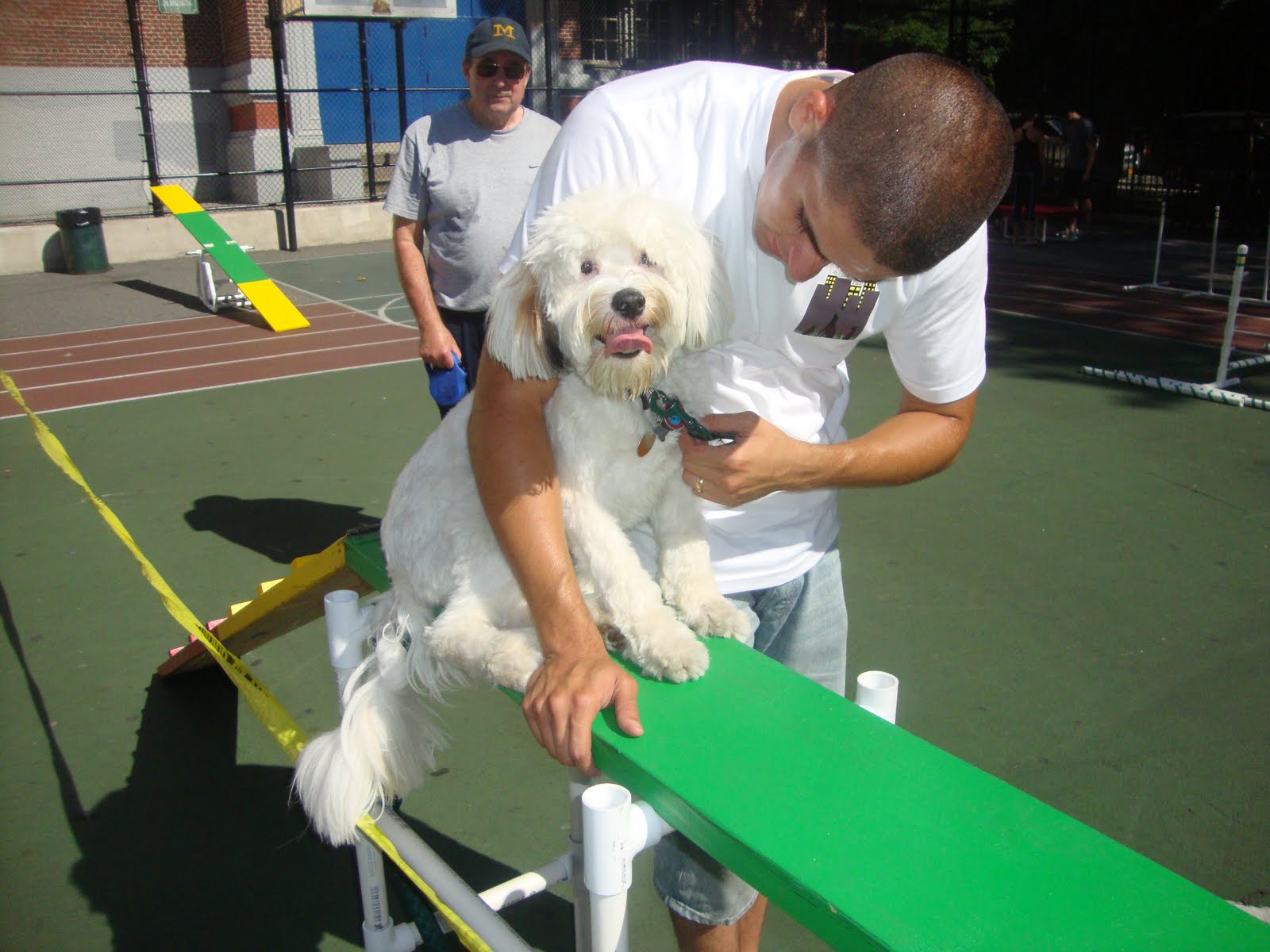
| Casper and me working on the dog bridge |
| Soho is getting so good! |
| Julie getting some shade after a great performance |
| Riley flew by the most difficult obstacle in her first class |
| Molly warming up before the class |
Thursday, July 14, 2011
House Breaking 101
![]() |
| Good example of a crate proportioned to the dog's size. |
Now follow these simple rules to help house break your dog. If you have any questions or if you think you need help house breaking your dog, contact us.
1. Get a high quality crate that is appropriate for your dog's size. Your dog only needs room to stretch it's body and turn around freely in the crate. Dog's do not like to eliminate in areas where they rest or sleep. If you get a crate that is too large, your dog will eliminate in one side of the crate and rest in the other. If you get a crate that is too small, your dog will be uncomfortable. Don't worry, crates aren't inhumane. If you desensitize your dog to the crate properly, it will learn to love it. Never use a crate as a punishment or as a time out.
2. Keep your dog in the crate unless you can directly supervise your dog until it has been fully house broken. This does not mean you can leave your dog in the crate all day. Keep in mind puppies can go with out relieving themselves for about an hour for every month of age until they reach about 8 months. So follow this rule of thumb when trying to determine how long it is appropriate to leave your dog in the crate.
3. Also keep in mind that dogs usually have to relieve themselves after they eat, sleep and exercise. So make sure you provide a walk after these activities.
4. Make a dog walking and feeding schedule and stick to it! Dogs love routines and if you follow it consistently, your dog will develop an internal clock that will let them know it is time to eliminate. Make sure you provide food and water at the same times every day. Do not leave food and water out all day for your dog to eat and drink. It may seem cruel but as long as you are providing enough food and water, your dog will not go hungry or thirsty. It may be difficult to maintain a schedule if you work full time so if you can, hire a dog walker to help you with walking and feeding.
![]() |
| House breaking pads slow down the house breaking process. |
6. Keep your dog's living area clean. If your dog can smell areas in your home where it has eliminated in the past, it will have even more of an urge to do it again. Your dog can smell odors that we can't detect. There are products that can help eliminate these odors. One of my favorite products is nature's miracle.
7. If your dog is out of the crate and you are supervising it (which you should be) and it begins to relieve it's self in the house, it is important that you startle your dog. The most important thing is that you catch them in the act. This is why it is important to supervise your dog every time it is outside of the crate unless the house breaking process has been completed.
When house breaking a dog, everyone in the dog's family must be on the same page and work together. You also must be consistent and go at it 100 percent. If you put in 50 percent effort, you'll get 50 results!
Sunday, July 10, 2011
Our free dog agility classes are back!
| Molly the Cockapoo |
| Casper the Tibetan Terrier |
| Soho the Belgium Malinois |
| Foo Foo the Chihuahua |
Today we had our first free dog agility class in a few weeks so I was thrilled to get things going again. We were working on changing the location of the classes but we got such great feedback from all of the people who attended past classes, so we decided to stay in St. Catherine's park. We changed the time of the class to 9:00 am to 10:00 am because we figured the morning will have much cooler temperatures for the dogs. Today the class was great. It was a pretty small class because of the time change but we did have a couple of new dogs show up and show off their skills. One new dog that impressed me was Soho, a 5 and a half month old Belgium Malinois who started off very shy but finished strong after she was able to build her confidence. Molly the cockapoo was the most experience dog there and she helped me introduce some of the new dogs to the agility course (thanks Molly!). We will having our class again next Sunday at 9:00 am. Hope to see you there!
Wednesday, July 6, 2011
Choosing the right equipment for your dog.
There are countless types of leashes, collars and harnesses in the market which makes it difficult to choose the right ones for you and your dog. My advice is to choose a piece of equipment that you (the handler) feels comfortable using. Also, I suggest you consult a professional dog trainer who isn't completely against using any particular piece of equipment. Another thing to consider is that there is no piece of equipment that will be the best for any dog. What works well with one dog may not work well with another. Before I get into the different types of equipment I want to briefly discuss collapsed tracheas and dogs. Many people choose not to use collars on their dogs in order to prevent a collapsed trachea. Out all my years of working with dogs I have never heard of a dog getting a collapsed trachea from using a collar. Some dogs are just prone to getting this condition and some dogs that only wear harnesses get collapsed tracheas. If your dog has already been diagnosed with this condition I would avoid dog collars but I wouldn't avoid collars to prevent it.
Now for the rest of the blog I will describe different types of equipment in the market today and I will discuss the pros and cons of each piece of equipment. If you have any questions after reading this blog, feel free to contact us.
Flat Collars: These are the most commonly used pieces of equipment by dog owners today.
Pros: They give you control over your dog and they come in an endless variety of styles and colors.
Cons: They have to be fitted very snug in order to prevent your dog from slipping out of them. Because they have to fit so snug, they can be pretty uncomfortable for your dog.
Body Harnesses: These are also commonly used and they are growing in popularity. Mainly because many people believe they are the most humane piece of equipment to use on your dog.
Pros: Probably the most comfortable piece of equipment for your dog. They look nice and come in many styles and colors. Good alternative for dogs with collapsed tracheas.
Cons: They give you little or no control of your dog. What many people don't realize is that they were made to train dogs to pull materials and for scent tracking so that the dog can keep it's head low to the ground and pull it's handler to the object it is tracking. When ever I see a dog in a harness pulling it's owner (which I do everyday), I know the dog is doing excactly what it should be doing. Harnesses have their place in dog training, but most of the time leash etiquette is not that place. Also, while they look very secure, dogs often back up out of them. If a dog can get a leg out of a harness, they can easily slip the rest of their body out.
Choke/ slip collars: Probably the most commonly used collars amongst dog trainers. They must be fitted to a proper setting with the dog remaining on one side of the handler during their walks. Calling this piece of equipment a choke collar gives it a bad name. I prefer to call it a slip collar. You should consult a professional before using a slip collar.
Pros: They give you great control of your dog. If fitted and used properly, they hang on a dogs neck like a piece of jewelry. Thus making it very comfortable for a dog to wear. They make it virtually impossible for your dog to escape.
Cons: If not used properly, you can hurt your dog using slip collars. Also, slip collars do restrict the dog's airway when given a correction or when the dog pulls.
Prong collars: Probably the most misunderstood piece of equipment. They are made to simulate a disciplinary bite dogs give when another dog is out of line. It is necessary to either consult a professional before using this piece of equipment or do extensive research. The prongs in the collar are not sharp and they cannot penetrate the dog's skin because the prong make contact with the dog's skin diagonally.
Pros: They give you the most control of your dog. Often nicknamed "power steering for dogs" by dog trainers. Unlike other collars, they do not restrict the dog's airway.
Cons: They look very intimidating. The links in the collar often pop off, so a slip collar should be used as a back up. If used incorrectly you can hurt your dog. You may get some dirty looks by people who think prong collars are inhumane.
Shock/Electric/Remote Collars: To accurately explain this piece of equipment I need to write a whole blog on them. First of all, I call them remote collars. Calling them shock or electric collars makes them seem worse than they really are. They are made to give the dog an electric stimulation whenever the handler presses a button on a remote. The stimulation is usually no greater than the sensation one gets from a static shock. These should only be used by professionals or by someone who has been trained by a professional. If used properly remote collars can be a very humane way to train your dog.
Pros: A great way to communicate with your dog when you are not next to them. It is a safer and more humane alternative to constantly having to give your dog leash corrections. Great for off leash training. Very affective for problematic behavior.
Cons: Dog handlers must have extensive training before using remote collars. They attract bad attention from people who think remote collars are inhumane. If used incorrectly, they can do more harm than good. There are only a few name brands worth buying and they can be expensive.
Head Halti/Head Collar/Gentle Leader: These collars are meant to be fitted on a dog's head and muzzle. These are relatively new but they are growing in popularity.
Pros: They do give you control of your dog without causing any physical pain. Good for dogs who overpower their handlers.
Cons: They come off a lot! While they do not cause physical pain, there is no piece of equipment that irritates dogs more than a Head Halti. The strap that goes around their muzzle causes a lot of discomfort. Personally, they are my least favorite piece of equipment to use on a dog. Many people believe they are good for correcting problematic behavior but they cover up behavior issues rather than fix them. I like to allow dogs to make mistakes so that I can correct them and they can learn from those mistakes. Head halti's make that impossible because they pull the dog away rather than correct them.
Now for the rest of the blog I will describe different types of equipment in the market today and I will discuss the pros and cons of each piece of equipment. If you have any questions after reading this blog, feel free to contact us.
![]() |
| Flat Collar |
Flat Collars: These are the most commonly used pieces of equipment by dog owners today.
Pros: They give you control over your dog and they come in an endless variety of styles and colors.
Cons: They have to be fitted very snug in order to prevent your dog from slipping out of them. Because they have to fit so snug, they can be pretty uncomfortable for your dog.
![]() |
| Body Harness |
Pros: Probably the most comfortable piece of equipment for your dog. They look nice and come in many styles and colors. Good alternative for dogs with collapsed tracheas.
Cons: They give you little or no control of your dog. What many people don't realize is that they were made to train dogs to pull materials and for scent tracking so that the dog can keep it's head low to the ground and pull it's handler to the object it is tracking. When ever I see a dog in a harness pulling it's owner (which I do everyday), I know the dog is doing excactly what it should be doing. Harnesses have their place in dog training, but most of the time leash etiquette is not that place. Also, while they look very secure, dogs often back up out of them. If a dog can get a leg out of a harness, they can easily slip the rest of their body out.
![]() |
| Choke/Slip Collar |
Choke/ slip collars: Probably the most commonly used collars amongst dog trainers. They must be fitted to a proper setting with the dog remaining on one side of the handler during their walks. Calling this piece of equipment a choke collar gives it a bad name. I prefer to call it a slip collar. You should consult a professional before using a slip collar.
Pros: They give you great control of your dog. If fitted and used properly, they hang on a dogs neck like a piece of jewelry. Thus making it very comfortable for a dog to wear. They make it virtually impossible for your dog to escape.
Cons: If not used properly, you can hurt your dog using slip collars. Also, slip collars do restrict the dog's airway when given a correction or when the dog pulls.
![]() |
| Prong Collar |
Pros: They give you the most control of your dog. Often nicknamed "power steering for dogs" by dog trainers. Unlike other collars, they do not restrict the dog's airway.
Cons: They look very intimidating. The links in the collar often pop off, so a slip collar should be used as a back up. If used incorrectly you can hurt your dog. You may get some dirty looks by people who think prong collars are inhumane.
![]() |
| Remote Collars |
Pros: A great way to communicate with your dog when you are not next to them. It is a safer and more humane alternative to constantly having to give your dog leash corrections. Great for off leash training. Very affective for problematic behavior.
Cons: Dog handlers must have extensive training before using remote collars. They attract bad attention from people who think remote collars are inhumane. If used incorrectly, they can do more harm than good. There are only a few name brands worth buying and they can be expensive.
![]() |
| Head Halti |
Head Halti/Head Collar/Gentle Leader: These collars are meant to be fitted on a dog's head and muzzle. These are relatively new but they are growing in popularity.
Pros: They do give you control of your dog without causing any physical pain. Good for dogs who overpower their handlers.
Cons: They come off a lot! While they do not cause physical pain, there is no piece of equipment that irritates dogs more than a Head Halti. The strap that goes around their muzzle causes a lot of discomfort. Personally, they are my least favorite piece of equipment to use on a dog. Many people believe they are good for correcting problematic behavior but they cover up behavior issues rather than fix them. I like to allow dogs to make mistakes so that I can correct them and they can learn from those mistakes. Head halti's make that impossible because they pull the dog away rather than correct them.
Friday, July 1, 2011
Our Newest Member, Mabel the Puggle
| Mabel the Puggle |
| Mabel and Boomer after a long walk |
Subscribe to:
Posts (Atom)